Play Reversi Online Free
Do Not Rush to Flip the Most Discs
A three- or five-disc lead in the middle of a Reversi game rarely decides anything. Watch three things instead: whether your move hands your opponent a corner, how many legal moves each side has afterward, and who gets to move first into the last few empty regions. Start with a game against the beginner AI. Tap Hint when you are stuck, undo your mistakes, and use the replay at the end to find the move where the game turned.
What are you trying to do in Reversi?
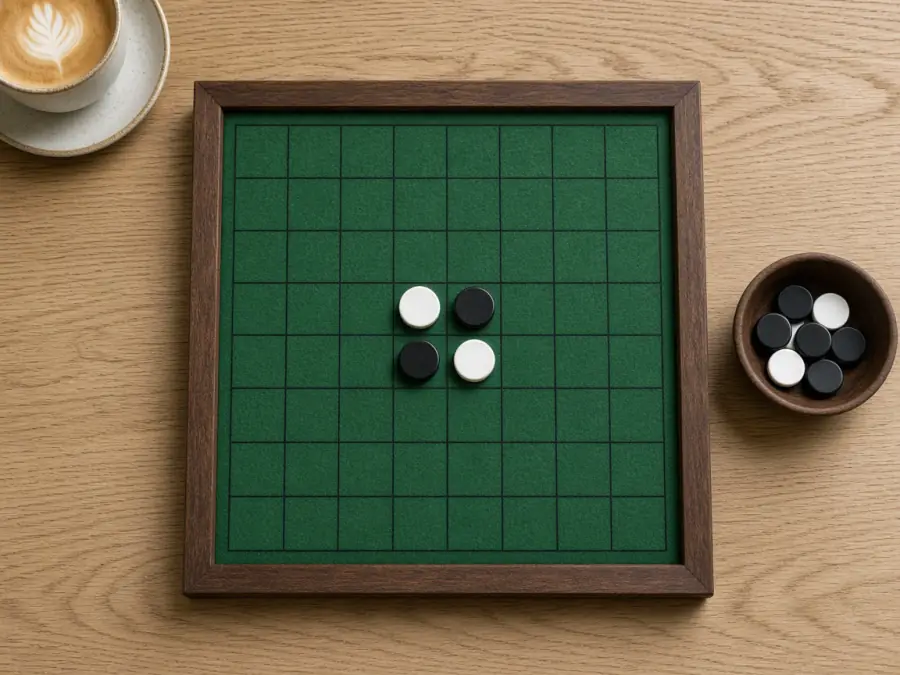
The game starts with two black and two white discs in the center, and Black moves first. Players take turns placing a disc on an empty square. The new disc must trap at least one opposing disc between itself and another disc of yours along a row, column, or diagonal, and every trapped disc flips to your color. A single move can flip along several lines at once. Discs never move after they are placed; they only change color when a later line closes around them.
If you have no legal move, you pass and your opponent plays again. The game ends when neither side can move or all 60 empty squares are filled, and the player with more discs wins. The idea most beginners have to unlearn is that flipping a lot in the midgame means you are winning. A disc on a corner can never be flipped back, and the more legal moves you keep, the easier it is to push your opponent onto squares they would rather avoid.
Coordinates run along the edges: columns a to h from left to right, rows 1 to 8 from top to bottom, so a1 is the top-left corner and h8 the bottom-right. Take your first game slowly. Before each move, glance at all four corners, then count the dotted squares for you and for your opponent. Even if you lose, the game paid off if the replay lets you say, “That is where I gave away a1.”
For the first game, practice one thing: do not give away a corner
Pick the beginner level. Before every move, scan all four corners. If you can take one, think about whether now is the right time. While a corner is still empty, keep off the square diagonally inside it, the X-square (such as b2), and be careful with the C-squares right beside it (such as a2 and b1). Those are the moves that most often hand the corner over. If you do give one away, undo, try a different move, and see whether the AI can still reach the corner. A game played this way teaches more than a game played only to win.
Why can a large disc lead still disappear?
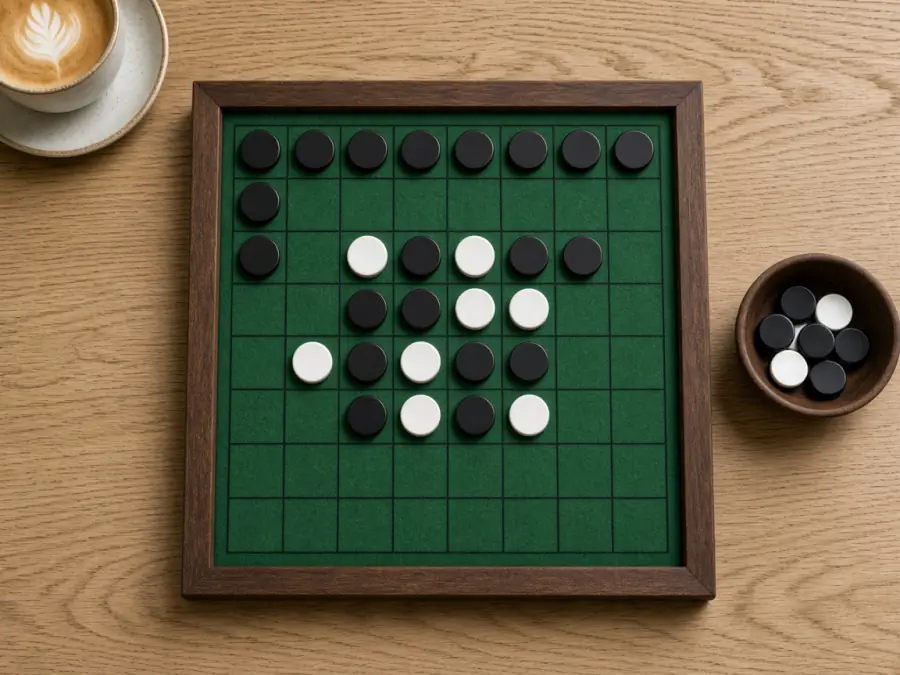
Flipping a big region in the midgame also leaves more of your discs next to empty squares, which opens fresh lines for your opponent. If you have six legal moves and they have two, you can be five discs behind and still steer clear of danger while forcing an awkward reply. That is why strong players often choose a quiet move in the midgame: one that flips a disc or two and stays away from the outside. The discs that really count are stable discs, the ones on corners and the ones joined to a corner along an edge where no line can ever close around them. They all survive to the final count, while ordinary midgame discs can be flipped back at any moment. Reversi stays interesting because of that gap between looking behind and actually having more freedom.
After the game, review only three turning points
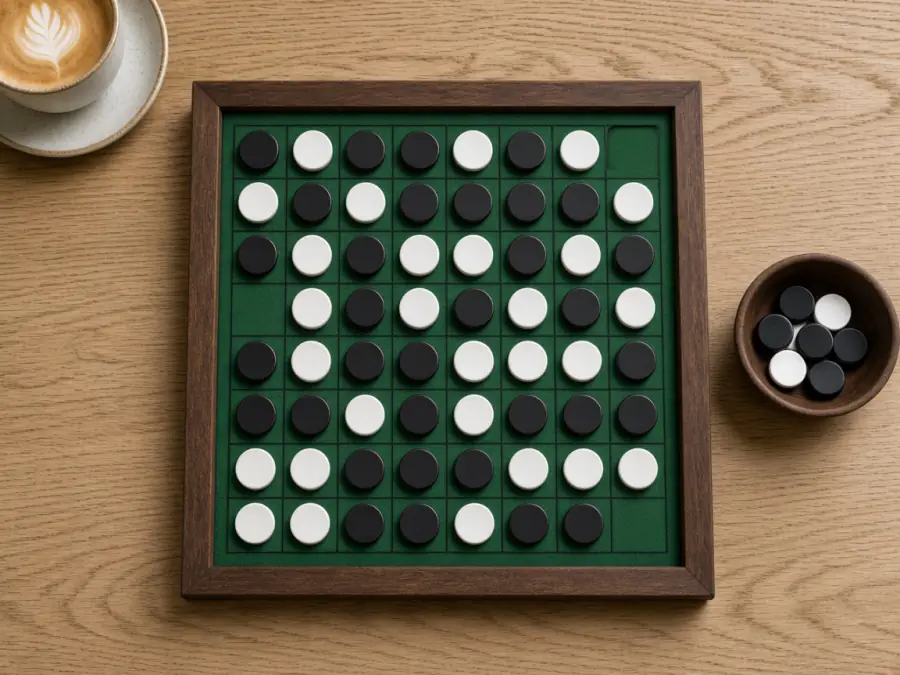
First find how the first corner was taken. Next, look at the position before the first pass and see whose legal moves were squeezed out. Finally, find the endgame move that changed who controlled the remaining empty squares. In the endgame, watch parity too: once the board splits into small empty regions, whoever plays last in each region gets a final flip that cannot be answered, so strong players try to leave odd-sized regions for themselves to finish. Once you have found all three turning points, you will know where to think harder next game. To test another idea, undo back to that move and let the AI reply again. It is far more reliable than guessing.
Frequently asked questions
Is Reversi the same game as Othello?
The rules are essentially the same. Othello is a trademarked name for the version that fixes the four starting discs in a crossed pattern with Black to move first, and that is the start this board uses. Reversi is the older, generic name for the game.
Does it cost anything, or do I need an account?
No. Open the page and you can play the AI, share one device with a friend, or set up an online room. There is no account to create and nothing to install.
How many AI levels are there, and which should a beginner pick?
There are multiple AI levels, and you can switch between them from the sidebar at any time. Start at the beginner level. Once you can avoid giving away corners and win the final count, move up one level.
Does the hint use the strongest AI level?
No. The hint uses the same search as the AI level you have selected, so at the beginner level it suggests what the beginner AI would play. For stronger advice, raise the level and tap Hint again.
How do I play a friend online, and what if I get disconnected?
Open the online room page, create a private room, choose Black or White, and send the link. Your friend opens it and takes the other seat. You can also join a waiting room from the public lobby. If you drop out, open the same link again to return to your seat and the current position.
What if it is my turn and I have no legal move?
You pass, and your opponent moves again. The board handles this for you. If neither side can move, the game ends and the discs are counted.
Why does everyone say corners matter most?
A corner disc can never be bracketed from any direction, so once you place it, it stays yours. It also anchors the edges next to it. That is why the most common opening and midgame mistake is playing an X-square or C-square and letting your opponent take the corner.
Is it good to flip as many discs as possible in the midgame?
Usually the opposite. Big flips put more of your discs next to empty squares, which gives your opponent new moves. Flipping fewer and leaving your opponent fewer choices is how you take control of the second half. The disc count only matters at the very end.
Can I undo a move, and how does the replay work?
Against the AI you can undo at any point and try a different move from there. When the game ends, open the replay to step through every move, which is the easiest way to find the move that gave away a corner or cut down your options.
Is my game saved, and can I continue on another device?
The current game is saved in this browser on this device, so refreshing the page will not lose it. It does not sync to other devices, and clearing your browser data clears the game too.